Tuesday, November 13, 2007

Protect Yourself and Your Family From Cold and Flu Viruses

The surest way to catch a cold or flu is to catch the germs that caused it. This is a known fact that we all recognize. Knowing this, most of us take precautious measures to remove cold and flu “bugs” from our homes, especially when one or more family members begin coughing or sneezing suspiciously. If you ask around, most people will tell you that spraying “hot spots” (door knobs, telephones, sinks, toilets, computer keyboards and video game controllers, etc.) with a known disinfectant, washing your bedding in hot water, using a hand sanitizer and frequently washing your hands will eliminate germs and keep you and your family healthy. While these are all excellent precautions and should be done a regular basis, is it really working?


Colds are the most prevalent infectious disease in the United States and are responsible for more school absences than any other illness. There are over one billion colds in the United States and currently an estimated 25–50 million cases of the flu reported each year — leading to 150,000 hospitalizations and 30,000–40,000 deaths yearly.

With such staggering statistics, what more can we do to protect our family members and ourselves?

Sanitize Your Toothbrush!

Why should you sanitize your toothbrush?

The answer is, simply enough, so we don’t get sick.

Many of us don’t consider the millions of microscopic germs and bacteria that are being removed from our teeth, gums, and tongue by our toothbrush when we brush- and few of us think about the fact that those disgusting germs and food particles continue to live, breed, and rot on the bristles of our toothbrush in between brushings.

We’ve known for a long time that germs cause disease and that we can protect ourselves by doing simple things like washing our hands and necessary things like sterilizing medical instruments.

But why hasn’t this wisdom been extended to our toothbrushes, which are FDA-regulated medical devices? For that matter, is there another medical device that comes into contact with the human soft mucous-membrane tissue that isn’t supposed to be sanitized before each and every use?


It is easy to see how the germs are spread around a room when a sick person is coughing or sneezing. Other times it is not so easy to spot the germs just waiting to pass the cold or flu virus your way. Needless to say, the mouth is one of the dirtiest parts of the body; not only are there millions of germs in there, it is the prime portal for infection to enter the body, and it is a major site of chronic and often undetected silent disease.

The bottom line is, every time we brush, we coat our toothbrush with millions of disease causing germs. Then we rinse our toothbrush under the tap for a few seconds, and throw it in the community cup with all the other germ-infested toothbrushes. We store that cup in the dirtiest room in the house- the bathroom- near the germ-laden toilet (a toilet with no trap which avails the room to sewer line gases each time the toilet is flushed) and sink, and we return to brush with the same toothbrush 6 to 12 hours later! We wouldn’t hang our forks or spoons in the bathroom exposed to bathroom vapors, germ laced dust and “bathroom bacterial mist”, but we have no problem doing this to our toothbrushes which are FDA regulated medical devices. We are literally injecting toothbrush germs directly into our bloodstreams every time we brush with an unsanitized toothbrush.
Are these germs a danger to your long-term health? Well, what do you think?

What does common sense tell you?

When you really think about it, using an unsanitized toothbrush is a nasty, disgusting practice that makes absolutely no sense at all.

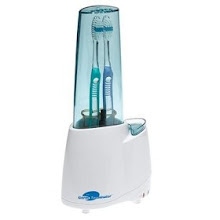
The Germ Terminator Toothbrush Sanitizer is an FDA-approved medical device, which means we had the Germ Terminator tested in three major in dependent laboratories. We tested the Germ Terminator against the common cold virus (rhinovirus), the flu (influenza), herpes (simplexes I and II), and E. coli among other disgusting germs that have been found on toothbrushes and the Germ Terminator passed every test.

Tuesday, October 30, 2007

The Dangers of Using Ultraviolet (UV) Light Radiation to Sanitize your Toothbrush

Some toothbrush sanitizing devices use ultraviolet light (UV radiation) to kill germs. How safe is UV radiation and how does it work?

Ultraviolet radiation kills cells, including germ cells, by damaging their DNA. That’s what radiation does. When the damage inflicted by the UV light radiation is extensive, the repair process can break down. The longer the cells are exposed to the ultraviolet light, the greater the risk of an incorrect repair or a “missed” repair, the cell cannot carry out its normal functions. Depending on the extent of the damage, the cell will die, or the cell mutates into a precancerous, cancerous cell, or a “super bug”.

Ultraviolet light is extremely powerful – up to 10,000 times the intensity of the sun - and it is has the power to permanently alter or mutate cells, that’s what radiation can do. Each day we hear more about the potential of “super bugs” to wreak havoc on our bodies and resist antibiotics. You would not want to infect yourself with germs in the first place, let alone “super germs” mutated by ultraviolet light radiation!

Also, the capacity of UV radiation to kill toothbrush germs is limited to only those areas of the brush that the light radiation can directly reach. The bristles of your toothbrush are tightly bound together at the bottoms, leaving dark areas in between where germs can hide and the radiation is unable to reach. If your bristles become worn or frayed after a few weeks of use, then the areas of the bristles exposed to the UV radiation can become even more limited.

There is a reason why the majority of health care facilities choose to sterilize their medical instruments with the power of steam. Because it is the safest, most reliable, and most effective way to ensure a germ free environment!

The Germ Terminator is the only toothbrush sanitizer that cleans your toothbrush using a powerful combination of steam and dry heat and stores your toothbrush in a completely germ-free environment until the next time you brush. Unlike other toothbrush sanitization systems that use ultraviolet light, the Germ Terminator's steam technology is proven to be the most effective way to kill toothbrush germs. Steam sanitization is natural and safe - no harmful chemicals and no ultraviolet light - even doctors and dentists rely on the power of steam to effectively clean their instruments!

To learn more, visit our website, www.germterminator.com.

Monday, October 15, 2007

HARVARD STUDY SHOWS GUM DISEASE CAN MORE THAN DOUBLE A PERSON'S RISK OF PANCREATIC CANCER

Dominique Michaud of the Harvard School of Public Health, led a study analyzing data of over 48,000 male health professionals -a large number of whom were non-smokers- who were followed for 16 years. Interestingly, more than half the men participating in the study are dentists.

They found that men who had reported gum disease were 64% more likely to develope pancreatic cancer than men with healthy teeth and gums. Men who lost teeth within the past four years were especially likely to develop pancreatic cancer. Among nonsmokers, those with gum disease were more than twice as likely to have pancreatic cancer. Past studies have also linked gum disease to pancreatic cancer but without factoring in smoking, which contributes to both gum disease and cancer.

“The association may be due to systemic (throughout the body) inflammation and/or increased levels of carcinogenic compounds generated by bacteria in the oral cavity of individuals with periodontal disease,” the researchers wrote.

Pancreatic cancer is the fourth-leading cause of cancer deaths in the United States. According to the American Cancer Society, it will kill 95 percent of the 32,000 people who get it this year.

These findings appear in the Jan. 17 issue of the Journal of the National Cancer Institute.

Jim Song, creator of the Germ Terminator Toothbrush Sanitizer, offers more information on the subject of silent inflammation and a suprisingly simple solution in his book, Why Your Toothbrush May Be Killing You... Slowly.

Click here to watch our Documentary

Tuesday, October 2, 2007

GINGIVITIS AND PERIODONTITIS LINKED TO CARDIOVASCULAR DISEASE

The past half century has seen the meaning of oral health evolve from a narrow focus on teeth and gingiva to the recognition that the mouth is the center of vital tissues and functions that are critical to total health and well-being across the life span. A good overall review of the relationship between Periodontal Disease and other systemic diseases may be found at the website of the American Academy of Periodontology, http://www.perio.org/.

The most significant research finding was that of The First National Health and Nutrition Examination which followed 9760 subjects for 14 years. This survey found that individuals with periodontitis at baseline has a 25% greater chance of having coronary artery disease.

It was once thought that the presence of subgingival plaque and calculus resulted in gingivitis and that if left untreated, gingivitis would always progress into periodontitis. More recently it has been shown that certain bacteria cause periodontal disease.

US Department of Health and Human Services, Oral Health in America: A Report of the Surgeon General- Executive Summary, Rockville, MD: National Institute and Craniofacial Research, National Institutes of Health, 2000. www.nider.nih.gov/sgr/execsumm.htm.

This report, and the actions produced by it, will have great impact on the expanding role of dentistry, and the way that dentistry is practiced as an integral part of the health care system in the future. Some key quotations from the report;

"The terms oral health and general health should not be interpreted as separate entities. Oral health is integral to general health; this report provides important reminders that oral health means more than healthy teeth and that you cannot be healthy without oral health."

"A thorough oral examination can detect signs of nutritional deficiencies as well as a number of systemic diseases, including microbial infections, immune disorders, injuries, and some cancers. Indeed, the phrase, "the mouth is a mirror" has been used to illustrate the wealth of information that can be derived from examining oral tissues."

Finally, there is a safe, simple and completely effective solution to the dirty problem of toothbrush germs, and it makes perfect sense. There are actually a few methods floating around out there, but only one is the safest, most reliable, and most effective: the Germ Terminator Toothbrush Sanitizer. Using the Germ Terminator Toothbrush Sanitizer is hands-down the beset way to make sure that your toothbrush is completely germ free. The Germ Terminator Toothbrush Sanitizer uses the proven power of steam to kill all germs, bacteria, viruses, fungi (molds and yeasts) and any other disgusting microbes that may have collected on your toothbrush. Most importantly, the Germ Terminator Toothbrush Sanitizer also provides a clean, germ-free environment where your toothbrush can be safely stored until the next time you use it.


Highly Recommended
Hundreds of thousands of people have purchased the Germ Terminator and are amazed by the product. In a recent customer survey, over 92% of our current customers would recommend the product to family or friends.

The Germ Terminator Toothbrush Sanitizer is also recommended by doctors, dentists, and dental hygienists, and is approved by the FDA.

Friday, August 24, 2007

American Dental Association Library lists book by the inventor of the Germ Terminator


“Why Your Toothbrush May Be Killing You…Slowly”, a book written by James Song, a biochemist from the University of Michigan and inventor of the Germ Terminator Toothbrush Sanitizer, has been recognized and listed in the American Dental Association Library.

The ADA Library contains an extensive collection of books and journals, covering all areas of dentistry and oral health, including clinical, research, practice management and historical topics. The Library's services are primarily for ADA members and staff, however, certain services are also available to non–member dentists and other health professionals, as well as on-site services for patients in need of information.

The author of this eye-opening book not only states his theory, but he offers the solution.

The Germ Terminator Toothbrush Sanitzer cleans, sanitizes, and stores your toothbrush in a safe, germ free environment. The only product of its kind to use steam and dry heat to sanitze your toothbrush, the Germ Terminator is also easy enough for everyone to use and takes only seconds to eliminate 99.9999% of all toothbrush germs.

Take a look at our product demo to see how quickly and easily the Germ Terminator can work for you!

Wednesday, August 8, 2007

Germ Terminator Featured on QVC


On Tuesday, August 7th at 3pm, Jim Song, inventor of the Germ Terminator Toothbrush Sanitizer, was invited to present his amazing product on QVC Problem Solvers.

Recognized as "The Toothbrush Guy", Jim clearly stated what years of research combined with basic common sense tells us; if something is dirty, it should be cleaned...especially something we will routinely put in our mouths.

Once again proving the awesome power of steam and dry heat, Jims demonstration delivered the staggering facts about toothbrush germs, the resulting health risks, and the surprisingly simple solution.

With the Germ Terminator Toothbrush Sanitizer, when you hear it steam, you know it's clean!

If you saw the Germ Terminator on QVC, we want to hear from you.
Post your comments, questions, or ideas!

Missed us on QVC?
Click here to buy now or to learn more about the Germ Terminator Toothbrush Sanitizer!


Wednesday, July 18, 2007

Why Your Toothbrush May Be Killing You ... SLOWLY


The new book by the inventor of the Germ Terminator describes one man's mission to inform the public about a serious health threat that most of us have never even thought about-chronic brushing with germ-contaminated toothbrushes. It is undisputed by dentists, physicians, dental hygienists, and micro-biologists that toothbrushes, once used, become dental biohazards.

This book tells an alarming story of the silent, pathogenic germs that grow and breed inside the pointed bristles of our toothbrushes; prickly toothbrush bristles that cause daily microscopic cuts and abrasions to the soft, mucous-membrane tissues of the oral cavity, consequently, injecting germs (and their corresponding endotoxins) directly into our bloodstreams. By brushing with chronically dirty toothbrushes, we risk infecting our mouths with germs that can spread throughout the body- to the heart, kidneys, liver, brain, and anywhere else our bloodstreams will take them. Once they arrive at their destinations, they can nest, flourish, and take on lives of their own, causing silent havoc and constant stress to our immune systems.

The counterattack launched by our immune systems produces a quiet inflammatory build-up throughout our bodies. Year after year, decade after decade, this chronic inflammation, the buzzword in medical research today, may promote devastating diseases and health problems including, but not limited to, heart and lung disease, stroke, diabetes, Alzheimer's, bacterial pneumonia, adverse pregnancy outcomes, cancer, chronic fatigue, and many other chronic degenerative diseases.

Brushing with contaminated toothbrushes turns the practice of oral hygiene on its head and may help explain why 90% of adults suffer from some form of periodontal (gum) disease. Furthermore, it may be destructive to long-term health, and is diametrically opposite to contemporary medical knowledge combined with common sense, which tells us that if something is dirty, it should be cleaned. The author of this eye-opening book not only states his theory, but he offers the solution.