Germs can cause illnesses that range from common ailments like the cold or flu, to disabling conditions such as meningitis and E. coli poisoning, to deadly diseases like Hepatitis and HIV, to diseases linked to chronic inflammatory diseases such as Alzheimer’s or Parkinson’s.
Being sick costs too much, both financially and in the quality of our lives. The Centers for Disease Control says, “An ounce of prevention keeps the germs away”.
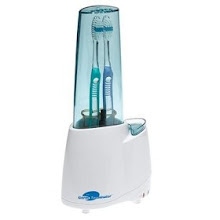
With the Germ Terminator, you will kill 99.9999% of all germs on your toothbrush, including bacteria, viruses, and fungi.
The world is filled with good germs that we need as well as bad germs that can make us sick or make us die. The recent SARS virus created a worldwide sense of fear and anxiety of just how vulnerable we can be to some germs.
The lesson is simple- we need to do everything we can to protect ourselves against the “bad” bacteria and “bad” viruses that really pose a threat to our health. We need to keep them out of our bloodstreams and keep them from causing chronic, silent, symptom-less, and undetected inflammation throughout our bodies.
Chronic inflammation is the “secret killer”.
Thursday, July 3, 2008

Thursday, June 19, 2008
Keeping It Clean

As crucial as it is to effectively kill toothbrush germs, it is equally important to provide a sanitary environment in which your toothbrush can be stored in between brushings. What good is it to eliminate all of the germs on your toothbrush only to leave it out in the open air, exposed to loads of disgusting airborne germs from the bathroom and neighboring toothbrushes?
Always remember, your toothbrush is a magnet for germs!
The Germ Terminator is designed with a dry-heat, germ free clean chamber that guards each toothbrush against microbial contamination from any outside source, including the bathroom and germs from other brushes. Call it "the no germ zone". Once a toothbrush has been sanitized in the Germ Terminator, it remains sanitized in the clean chamber until the next toothbrushing.
The specialized clean storage compartment is kept germ free by the dry heat mode, which is effective in killing germs, but more importantly, provides for upward air movement (since hot air rises) so that microorganisms will not settle inside the chamber or on your toothbrush. It also leaves your toothbrush nice and warm until the next time you use it. Independent lab testing proved that upon removing toothbrushes for the Germ Terminators clean chamber 12 hours after they had been sanitized, absolutely no microorganisms were detected on any toothbrush after any test!
It just makes sense!
Wednesday, June 4, 2008
Germ Terminator - FAQ

What types of toothbrushes can be used in the Germ Terminator?
In general, the Germ Terminator works with nearly all name brand toothbrushes. This includes both ultrasonic and mechanical toothbrushes. However, we do not recommend that is be used with clear handled toothbrushes or mechanical battery operated toothbrushes that do not have a removable head.
How many toothbrushes will the Germ Terminator sanitize at one time?
It has been designed and tested for sanitizing either one or two toothbrushes with bristles up.
How big is the Germ Terminator?
It's very compact and has a small footprint to sit on your countertop. It's base is only 3" x 5" and it stands about 12" in height.
How does the Germ Terminator work?
The Germ Terminator uses a patented and patent-pending two-step process using both steam and dry heat. You just add water to the unit and the power of steam kills greater than 99.9999% of the germs tested. The dry-heat clean chamber stores your toothbrush and keeps it germ-free.
Adding water automatically turns on the Germ Terminator steam mode and the dry-heat mode is activated automatically as soon as the steam cycle has been completed. There are no moving parts to break or jam. Your sanitized toothbrush stands ready for your next brushing.
What steps are required to clean my toothbrush?
The Germ Terminator is super-easy to use and takes less than ten seconds of your time per use. After placing your toothbrush into the clean chamber simply add water and the Germ Terminator automatically does the rest.
Does it use electricity?
The Germ Terminator plugs into the wall to enable your toothbrush to stay germ free even in unsanitary bathroom conditions.
Does it really work?
Three major independent laboratories were unable to detect even a single germ in any test. Each test involved contaminating toothbrushes with more than one million colony-forming units of germs per toothbrush. The Germ Terminator completely killed: HIV, Herpes, Hepatitis, The Cold Virus, The Flu Virus, Salmonella, Listeria, E. Coli, Candida, Gingivalis, Staphyloccocus, and Meningitis to name a few.
Does is come with a warranty?
The Germ Terminator Corporation warrants this product against any defects in material or workmanship for a period of 90 days from the date of purchase. An extended warranty is available through Germ Terminator Corporation.
How hot will the outside of the unit get?
The Germ Terminator is similar to any household appliance that uses steam. Like a humidifier, it becomes warm but not uncomfortable to the touch.
How long does it take for my toothbrush to be sanitized?
All you do is add water to your Germ Terminator and using it only takes 10 seconds. However, the steam process takes less than 10 minutes. The independent laboratories tested at 30 minutes, 4 hours,s and 12 hours. All tests showed complete inactivation of all germs.
Are there other ways to sanitize my toothbrush?
Boiling your toothbrush or placing your toothbrush in the dishwasher can damage the bristles of your brush. Also, these methods will not provide sanitary storage for your brush. Also, keeping your toothbrush in mouthwash may inject alcohol into your bloodstream. Alcohol is know to be a potential cancer-causing agent, especially for the oral cavity.
Thursday, May 15, 2008
Germs, not genes, cause most diseases.
Throughout history, germs have always been drastically underestimated in their ability to cause destruction and death. Germs have repeatedly been overlooked and rejected by the medical establishment as causes for disease. Perhaps this is because germs are invisible to the human eye and it is hard for us to believe that something we cannot see can have the ability to cause great harm to our "formidable" bodies. Whatever the case may be, the fact remains that microscopic germs can be, in fact, very harmful to our health.
As scientists discover more about them and their connections to certain diseases and conditions, germs are turning out to be more dangerous and sinister than we ever thought. In the past few years, several new studies and laboratory conclusions have pointed to germs as the instigators of many devastating non-acute diseases - chronic diseases that doctors used to think were caused by poor lifestyle and bad genes. What we are discovering is that the symptoms of long term bombardment by germs are generally undetected until they turn into something devastating like heart disease or cancer later in life.
The damage that germs can do is comparable to cigarette smoking, obesity, and lack of exercise. A little won't kill you but year after year, decade after decade, the snowball causes an avalanche which buries you.
Click Here for the Germ Terminator Solution!
As scientists discover more about them and their connections to certain diseases and conditions, germs are turning out to be more dangerous and sinister than we ever thought. In the past few years, several new studies and laboratory conclusions have pointed to germs as the instigators of many devastating non-acute diseases - chronic diseases that doctors used to think were caused by poor lifestyle and bad genes. What we are discovering is that the symptoms of long term bombardment by germs are generally undetected until they turn into something devastating like heart disease or cancer later in life.
The damage that germs can do is comparable to cigarette smoking, obesity, and lack of exercise. A little won't kill you but year after year, decade after decade, the snowball causes an avalanche which buries you.
Click Here for the Germ Terminator Solution!
Friday, May 2, 2008
Did You Know...

• More women than men report brushing before going out and more women are likely to brush their teeth at work or in a restaurant bathroom.
• Three out of four patients don’t change their toothbrush as often as they should.
• In 1857, H.N. Wadsworth was credited as the first American to patent the toothbrush.
• 94% of Americans say they brush nightly and 81% say they do it first thing in the morning.
• 38.5 = the total days an average American spends brushing teeth over a lifetime.(AAP)
• Women smile about 62 times a day compared to men who smile on average 8 times a day.
• Right handed people tend to chew food on the right side, while left handed people tend to chew on the left.
• More than 51 million hours of school are lost each year by children due to dental related illness.
• Adults lose more than 164 million hours of work each year due to oral health problems or dental visits.
• Like fingerprints, everyones tongue print is different.
• Tooth decay remains the most common chronic disease among children ages 5-17 with 59% affected.
• 32% of Americans cite bad breath as the least attractive trait of their co-workers. (AAP)
• 78% of Americans have had at least 1 cavity by age 17. (CDC, 2002)
• 75 percent of the U.S. population has some form of periodontal gum disease.

Tuesday, April 15, 2008
The Dirtiest Room in the House
In addition to the germs already existing in the mouth that end up on the bristles of your toothbrush and breed and multiply, millions of germs and bacteria can assemble on your toothbrush from its everyday storage environment, the bathroom.
The typical household bathroom is popularly known as "the dirtiest room in the house" for a reason. Even if you take care to neurotically clean the bathroom in your house every 2 to 3 days, there is no doubt that loads of germs, blood, and other bodily fluids are flying around as a result of hand-washing, toilet flushing, bathing, shaving, or any of the other grooming and personal hygiene activities that we carry out inside this little room.
Aside from the "bacterial mist" that is evident after each toilet flush and can stay in the air for at least two hours, the highest incidence of nasty bathroom germs actually occurs within and around the sink! That's right, the same place where you wash your face and hands, and brush your teeth every day!
How many of us rest our toothbrushes on the surfaces of a dirty sink, or how many of us have had our toothbrushes slip into the same dirty sink or even the floor? If you are like most people, the toothbrush is conveniently stored on or next to the the sink, contained within the infamous "community cup" holding the toothbrushes of every person in the household. It's here in the decorative and grimy family toothbrush cup that toothbrushes can actually share germs. This convenient storage habit is why the Journal of the Canadian Dental Association has stated that "toothbrushes can transmit disease." In technical terms, this is described as "cross-contamination.
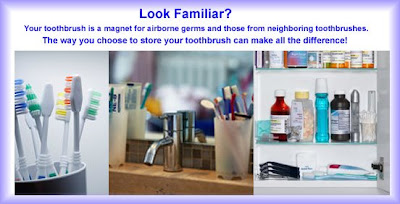
No matter how much of a germ freak you may call yourself or how often you clean your bathroom and practice techniques to limit the toilet "aerosol effect" and control the amount of sink germs that reach your toothbrush, unfortunately, there is virtually no escaping toothbrush germs. Even new toothbrushes aren't safe. A study published in the Journal of the Oklahoma Dental Association found that 4 out of 5 (80%) brand new toothbrushes from one manufacturer were contaminated right out of the box!
Instead of buying a new toothbrush each time you brush, as they are getting more and more expensive and some are contaminated anyway, why not sanitize your toothbrush and kill the germs? Now that there is a way to solve this dirty little problem, you can easily use a clean, sanitized toothbrush, and protect your immune system from all of the nasty germs living on your toothbrush bristles. It just makes sense.
The typical household bathroom is popularly known as "the dirtiest room in the house" for a reason. Even if you take care to neurotically clean the bathroom in your house every 2 to 3 days, there is no doubt that loads of germs, blood, and other bodily fluids are flying around as a result of hand-washing, toilet flushing, bathing, shaving, or any of the other grooming and personal hygiene activities that we carry out inside this little room.
Aside from the "bacterial mist" that is evident after each toilet flush and can stay in the air for at least two hours, the highest incidence of nasty bathroom germs actually occurs within and around the sink! That's right, the same place where you wash your face and hands, and brush your teeth every day!
How many of us rest our toothbrushes on the surfaces of a dirty sink, or how many of us have had our toothbrushes slip into the same dirty sink or even the floor? If you are like most people, the toothbrush is conveniently stored on or next to the the sink, contained within the infamous "community cup" holding the toothbrushes of every person in the household. It's here in the decorative and grimy family toothbrush cup that toothbrushes can actually share germs. This convenient storage habit is why the Journal of the Canadian Dental Association has stated that "toothbrushes can transmit disease." In technical terms, this is described as "cross-contamination.

No matter how much of a germ freak you may call yourself or how often you clean your bathroom and practice techniques to limit the toilet "aerosol effect" and control the amount of sink germs that reach your toothbrush, unfortunately, there is virtually no escaping toothbrush germs. Even new toothbrushes aren't safe. A study published in the Journal of the Oklahoma Dental Association found that 4 out of 5 (80%) brand new toothbrushes from one manufacturer were contaminated right out of the box!
Instead of buying a new toothbrush each time you brush, as they are getting more and more expensive and some are contaminated anyway, why not sanitize your toothbrush and kill the germs? Now that there is a way to solve this dirty little problem, you can easily use a clean, sanitized toothbrush, and protect your immune system from all of the nasty germs living on your toothbrush bristles. It just makes sense.
Tuesday, April 1, 2008
Inflammation: "The Secret Killer"
It is a well established fact that chronic oral infections can significantly, if not certainly, increase the risk of acquiring or worsening serious health problems like heart and lung disease, diabetes, stroke, and premature or low birth weight. According to the American Diabetes Association, approximately 90% of adult Americans have or will have gum disease some time in their lives.
If we take a minute to consider gum disease, which is a kind of chronic bacterial infection, it is easy to see how this condition can contribute to systematic inflammation turned chronic. A chronic infection like gum disease can undoubtedly affect the way in which your body's inflammatory reaction performs. When let untreated, it can persist as an ongoing infection in our mouths. Remember, gum disease is caused by an infectious, contagious bacterium that invades the delicate soft tissue of our gums - and inflammation is what causes our gums to become red and inflamed.
Research on inflammation is uncovering a fascinating network of interconnections between various diseases that we never dreamed would be inter-related. Inflammation can explain the connection between chronic oral infections and heart disease, stroke, and diabetes, to name just a few. This is because chronic inflammation in one area of the body can affect the rest of the body, and when we treat inflammation in one part of the body, other parts of the body also become healthier. And it's why the former U.S. Surgeon General said, "You are not healthy without good oral health".
So if we eliminate the germs on our toothbrush bristles by sanitizing our toothbrushes prior to every use, then we can bring a final end to chronic infection and re-infection from germs on our toothbrushes, and hopefully help to prevent, or at least minimize, chronic mouth infections like gum disease. Putting an end to chronic mouth infections will eradicate the need for a chronic inflammatory response in the mouth, and thereby reduce inflammation throughout the body. Remember, the mouth is the body's prime gateway for bacterial invasion and infection. Why not do everything we can to prevent recurring instances of infection directly at the source?
If we take a minute to consider gum disease, which is a kind of chronic bacterial infection, it is easy to see how this condition can contribute to systematic inflammation turned chronic. A chronic infection like gum disease can undoubtedly affect the way in which your body's inflammatory reaction performs. When let untreated, it can persist as an ongoing infection in our mouths. Remember, gum disease is caused by an infectious, contagious bacterium that invades the delicate soft tissue of our gums - and inflammation is what causes our gums to become red and inflamed.
Research on inflammation is uncovering a fascinating network of interconnections between various diseases that we never dreamed would be inter-related. Inflammation can explain the connection between chronic oral infections and heart disease, stroke, and diabetes, to name just a few. This is because chronic inflammation in one area of the body can affect the rest of the body, and when we treat inflammation in one part of the body, other parts of the body also become healthier. And it's why the former U.S. Surgeon General said, "You are not healthy without good oral health".
So if we eliminate the germs on our toothbrush bristles by sanitizing our toothbrushes prior to every use, then we can bring a final end to chronic infection and re-infection from germs on our toothbrushes, and hopefully help to prevent, or at least minimize, chronic mouth infections like gum disease. Putting an end to chronic mouth infections will eradicate the need for a chronic inflammatory response in the mouth, and thereby reduce inflammation throughout the body. Remember, the mouth is the body's prime gateway for bacterial invasion and infection. Why not do everything we can to prevent recurring instances of infection directly at the source?
Subscribe to:
Posts (Atom)